0
0
Why checkpoint density drives accuracy, safety, and the race-day experience
March 2026
Race timing hasn’t changed much in over thirty years.
Start lines record when a race begins. Finish lines record when it ends. For decades, that was enough to deliver accurate results and satisfy most participants. But everything around race day has changed. Participants now expect live tracking and real-time updates. Spectators follow races from anywhere in the world. Race directors must monitor course flow, manage safety, and respond quickly when something unexpected happens.
Timing systems were originally built to answer one question: Who finished and when?
Modern races demand answers to many more:
- Where are participants on the course?
- Are split times accurate and consistent?
- Is the race unfolding as expected?
- Can potential issues be identified before they affect athletes?
To support those expectations, race timing has begun to evolve beyond finish-line reporting.
That evolution starts with a simple idea: checkpoint density.

Checkpoint density transforms race timing from a finish-line snapshot into full-course visibility.
From Finish-Line Timing to Full-Course Visibility
Traditional timing setups were built for a simpler era of racing. A start line, a finish line, and perhaps one or two intermediate checkpoints could deliver accurate results, but they offered limited insight into what was happening across the course.
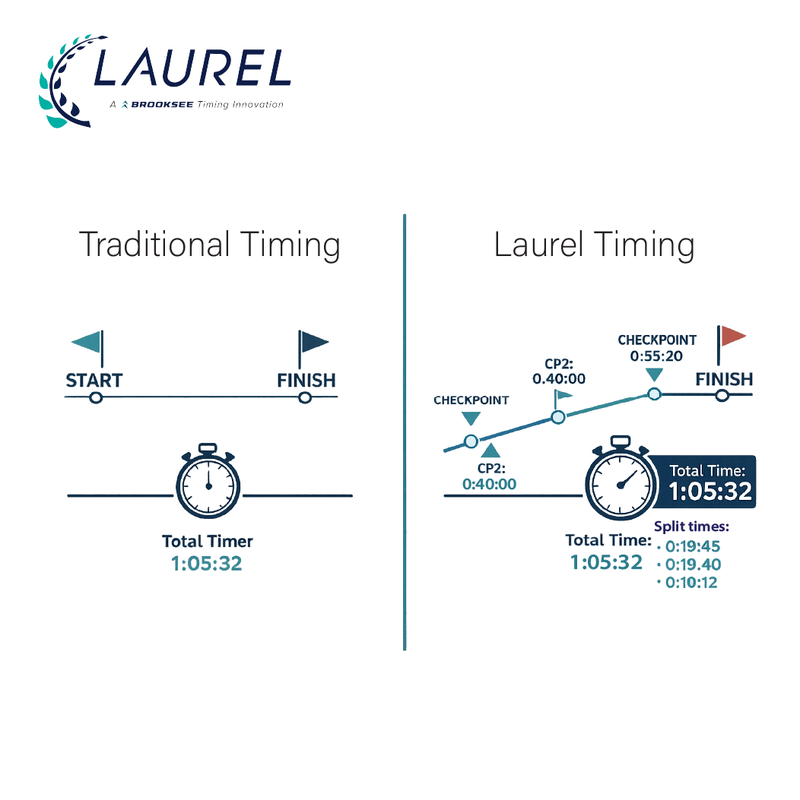
Once athletes spread out, visibility dropped quickly.
As races grew larger and more complex, this lack of real-time awareness became a challenge. Sparse timing points make it difficult to validate splits, understand race flow, or detect issues early. Race staff often find themselves reacting after problems occur rather than managing the race as it unfolds.
Modern race operations require more than post-race reporting. They require continuous awareness.
Checkpoint density changes that equation. By placing more checkpoints across the course, timing systems move beyond static result collection and become a real-time operational tool. Instead of relying on distant data points, race directors gain a clearer picture of where participants are and how the race is progressing.
Why Checkpoint Density Improves Accuracy, Safety, and Experience
At its core, checkpoint density reduces uncertainty.
When timing points are widely spaced, it becomes difficult to know exactly where an athlete passed between checkpoints. Frequent checkpoints narrow that window and provide more reliable context for race operations.
Higher checkpoint density supports several critical outcomes:
- Greater confidence in split data
- Faster identification of course or timing issues
- Stronger support for medical and safety teams
- More accurate live tracking for spectators
Live tracking, in particular, has become an expected part of the race experience. Friends and family follow participants throughout the event. Race staff use tracking data to monitor the field. Participants themselves engage with the race in new ways, often reviewing splits and pacing in real time.
Frequent, validated checkpoints allow tracking systems to deliver smoother updates without relying on large extrapolations that can create confusion or inaccuracies.
It is also important to distinguish between collecting more data and collecting better data. Effective timing systems emphasize validation, synchronization, and context. High checkpoint density works best when paired with infrastructure designed to verify reads, detect anomalies, and ensure the reliability of the information being shared.
The goal is not more data. The goal is clearer insight.
How Laurel Delivers True Full-Course Visibility
Laurel was built to address the gap between traditional timing and modern race-day expectations. The platform is designed specifically for high-density checkpoint networks, enabling rapid deployment across complex courses while maintaining data integrity and operational reliability.
By combining frequent reads with real-time validation and course-aware tooling, Laurel surfaces issues early and supports accurate live tracking throughout the event. Timing, monitoring, and operational context are unified into a single system, giving race directors clear, actionable visibility from start to finish.
Not just confidence in final results, but clarity throughout race day.
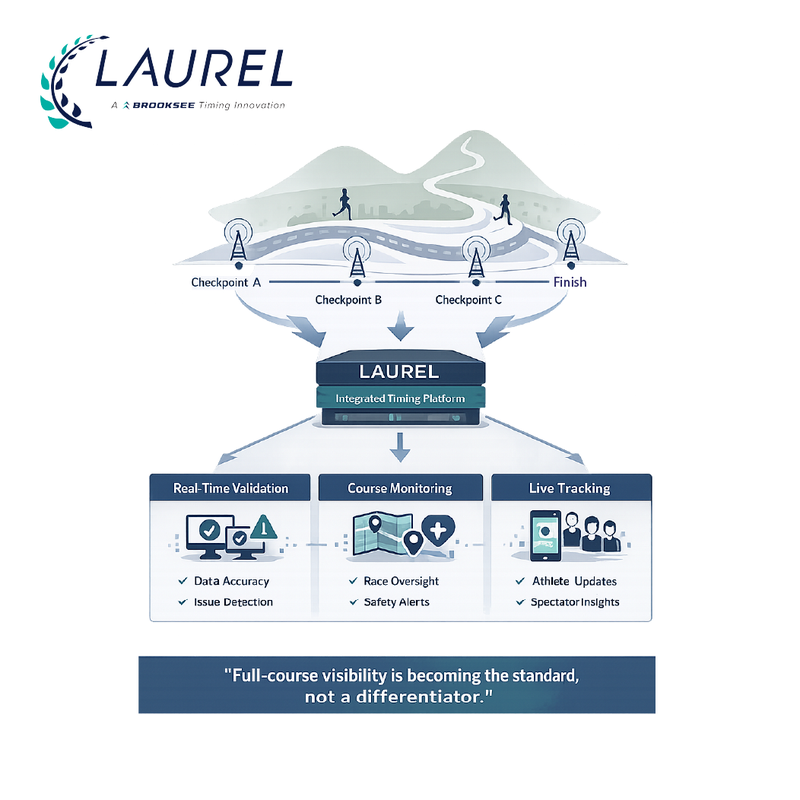
‘Full-course visibility is becoming the standard, not a differentiator.’