0
0
From Stopwatches to High-Density Checkpoint Networks
March 2026
Race timing has always answered one core question: how fast did someone complete the course?
But the way races measure that has changed dramatically over time. What began with clipboards and stopwatches has evolved into sophisticated tracking systems capable of monitoring thousands of athletes across miles of course in real time.
Understanding that evolution helps explain why modern timing systems are becoming a central piece of race infrastructure, not just a results tool.
From Manual Timing to Automated Systems
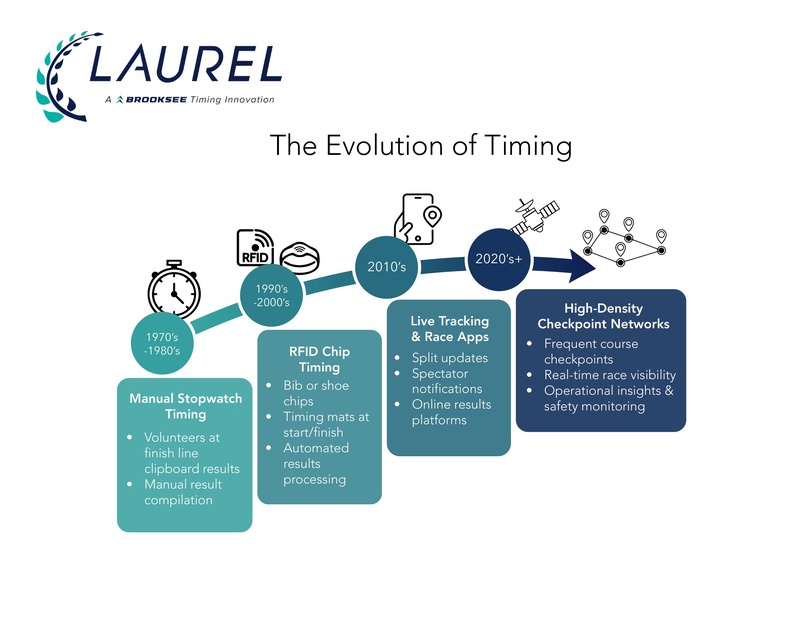
In the early days of road racing, timing was entirely manual. Volunteers stood at the finish line with stopwatches, recording bib numbers as runners crossed. While workable for small races, this approach struggled as participation grew. Results could take hours—or longer—to compile, and large finish groups increased the chance of human error.
The introduction of RFID chip timing in the 1990s was a major leap forward. Athletes carried a tag on their bib or shoe that triggered a read when crossing a timing mat. This allowed races to capture accurate start, split, and finish times automatically.
For the first time, timing moved beyond the finish line.
But even with chip timing, checkpoints were typically limited to a few locations: the start, finish, and perhaps a handful of splits along the course.
The Modern Expectation: Real-Time Race Visibility
Today’s race environment looks very different.
Participants expect live tracking. Spectators follow along remotely. Race directors need visibility across miles of course to support operations, safety, and storytelling.
This shift has changed what timing systems need to provide.
Instead of just producing results at the end, modern timing increasingly serves as a real-time information network for the entire event.
The Next Step: High-Density Checkpoint Networks
The newest evolution in race timing is the rise of high-density checkpoint networks.
Rather than capturing athlete progress only every few miles, these systems place checkpoints throughout the course—sometimes every tenth of a mile or less.
This increased checkpoint density allows races to:
- Improve tracking accuracy
- Monitor field movement across the course
- Enhance safety awareness
- Deliver better live updates to spectators
In other words, timing shifts from a simple measurement tool to a live operational system that helps races understand what is happening across the entire event.
Timing Is Becoming Event Infrastructure
Race timing has evolved alongside the sport itself.
From stopwatches to RFID tags to dense checkpoint networks, each step has expanded what race data can do.
Today, timing supports far more than final results. It powers athlete tracking, operational awareness, and spectator engagement.
And as expectations for real-time experiences continue to grow, checkpoint density is becoming one of the defining characteristics of modern race technology.