0
0
At any marathon start line, you'll see a spectrum of ambition packed into a single corral.
The elite runner in the front row. The first-timer several rows back. The back-of-packer who signed up on a dare and is already wondering if this was a mistake. The woman running her first race since having kids.
Their pre-race dialogues may differ, but underneath all of it, almost every one of them is thinking the same thing: I hope someone is watching.
What Is A Shout-Out?
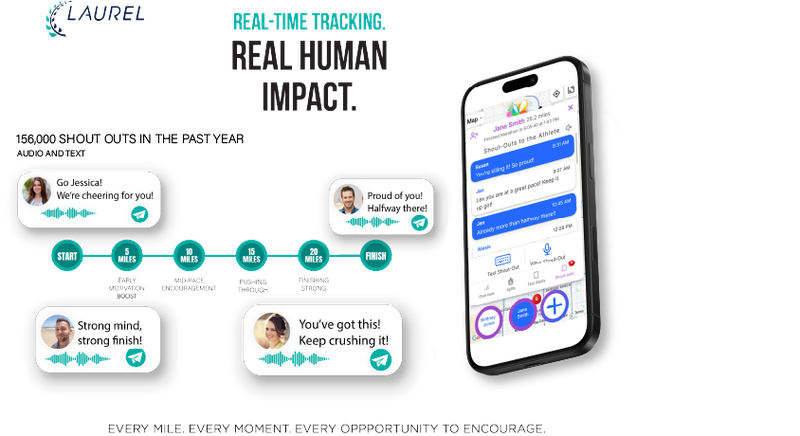
Laurel's live tracking platform lets supporters do more than watch a dot on a map. Through the shout-out feature, anyone following a runner can type a message through the app or record their own voice so the runner hears exactly who it's coming from.
This means runners can hear from a friend, family member, spouse, or coach during key race moments when an extra boost of encouragement could be exactly what they need to reach their goals.
The Science of Encouragement
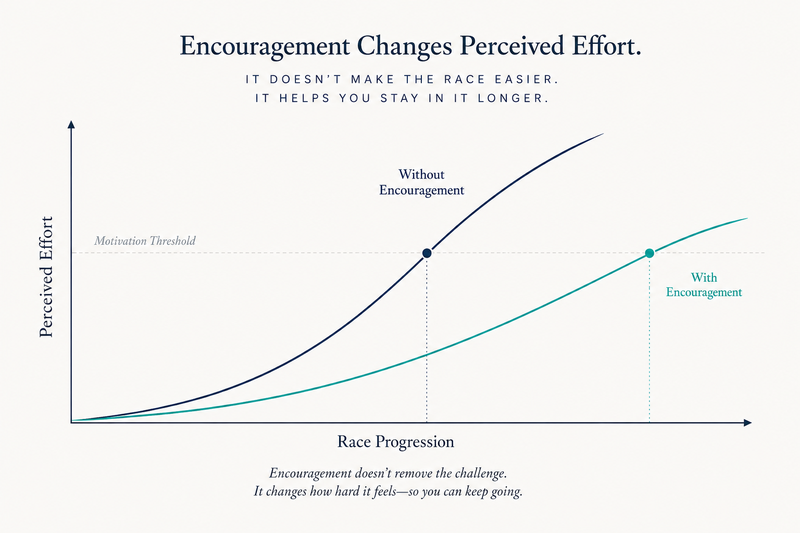
In the middle of a race, a runner hears an encouraging, "Keep going!" What happens? The brain registers the runner's effort as less taxing, allowing them to sustain higher effort for a longer amount of time.3,5,13 The brain is even more motivated if the voice is valued by the listener.7
Over decades, sports studies show the same thing: those who receive encouragement outperform those who do not receive encouragement.1,2,10,11,12 It's that simple.
When athletes quit, it is not always because the body cannot continue. Often, they quit when the price of continuing feels higher than their motivation.9,13
Encouragement is an antidote.4,6,8
In the past year, runners have received over 156,000 shout-outs through Laurel's live tracking platform.
More than 8,000 of those were audio: a supporter's actual voice, delivered in real time.
When Laurel launched the audio shout-out feature at the 2025 Every Woman's Marathon, the top four shout-out recipients received 235, 198, 185, and 167 messages.
Consider who produces numbers like that. Professional athletes or runners with media followings, yes, but also anybody whose community shows up in force.
The recipient with 185 shout-outs was a school principal whose students live-tracked from classrooms, sent their voices during hard miles, and showed up in a way a finish line photo could never capture. These supporters were choosing their moments.
They were inside the race.
High Engagement, High Reward
There's a reason supporters don't send one message and move on.
Live-tracking allows spectators to become invested. The impulse to send a shout-out isn't random. It's triggered by a specific split, stretch, or overall read of how their runner is doing now.
No matter where in the world the supporter is, the race followed becomes a spectator sport.
They become part of the crowd.
What This Means for Every Kind of Runner
Golf and Formula 1 didn't grow their audiences by explaining how the sport works. They grew them by making individual people into characters worth following, with stakes and moments of real drama playing out in real time.
Running has those moments. Every corral is full of them. What it hasn't had is the infrastructure to surface them for the people watching.
Whether it's the weekend warrior trying to finish, the mom getting back into her passion, or the elite trying to crush her PR, every runner has a story. Every runner needs a crowd. The athlete on the course for 6 hours has 6 hours of potential shout-out moments.
At the start line, runners hope someone is watching. With the right tools, someone always is.
References
- Andreacci JL, LeMura LM, Cohen SL, Urbansky EA, Chelland SA, Von Duvillard SP. The effects of frequency of encouragement on performance during maximal exercise testing. J Sports Sci. 2002 Apr;20(4):345-52. doi: 10.1080/026404102753576125. PMID: 12003280.
- Cotellessa F, Bragazzi NL, Trompetto C, Marinelli L, Mori L, Faelli E, Schenone C, Ceylan Hİ, Biz C, Ruggieri P, Puce L. Improvement of Motor Task Performance: Effects of Verbal Encouragement and Music-Key Results from a Randomized Crossover Study with Electromyographic Data. Sports (Basel). 2024 Jul 30;12(8):210. doi: 10.3390/sports12080210. PMID: 39195586; PMCID: PMC11359751.
- Davis A, Cohen E. The Effects of Social Support on Strenuous Physical Exercise. Adapt Human Behav Physiol. 2018;4(2):171-187. doi: 10.1007/s40750-017-0086-8. Epub 2018 Jan 11. PMID: 29755928; PMCID: PMC5935032.
- Davis AJ, Crittenden B, Cohen E. Effects of social support on performance outputs and perceived difficulty during physical exercise. Physiol Behav. 2021 Oct 1;239:113490. doi: 10.1016/j.physbeh.2021.113490. Epub 2021 Jun 15. PMID: 34139269.
- Davis AJ, MacCarron P, Cohen E. Social reward and support effects on exercise experiences and performance: Evidence from parkrun. PLoS One. 2021 Sep 15;16(9):e0256546. doi: 10.1371/journal.pone.0256546. PMID: 34525097; PMCID: PMC8443045.
- Edwards AM, Dutton-Challis L, Cottrell D, Guy JH, Hettinga FJ. Impact of active and passive social facilitation on self-paced endurance and sprint exercise: encouragement augments performance and motivation to exercise. BMJ Open Sport Exerc Med. 2018 Jul 27;4(1):e000368. doi: 10.1136/bmjsem-2018-000368. PMID: 30109119; PMCID: PMC6078239.
- Kanber E, Roiser JP, McGettigan C. Personally valued voices engage reward-motivated behaviour and brain responses. Soc Cogn Affect Neurosci. 2025 Jan 18;20(1):nsaf056. doi: 10.1093/scan/nsaf056. PMID: 40418223; PMCID: PMC12366989.
- Li X, Li H, Hwang J and Gao W (2026) The impact of perceived social support on athletic engagement among elite track and field athletes: an integrated perspective based on self-determination theory and social resources theory. Front. Psychol. 17:1763813. doi: 10.3389/fpsyg.2026.1763813
- Marcora, Samuele. (2019). Psychobiology of fatigue during endurance exercise. doi: 10.4324/9781315167312-2.
- McNair PJ, Depledge J, Brettkelly M, Stanley SN. Verbal encouragement: effects on maximum effort voluntary muscle action. Br J Sports Med. 1996 Sep;30(3):243-5. doi: 10.1136/bjsm.30.3.243. PMID: 8889120; PMCID: PMC1332340.
- Moffatt RJ, Chitwood LF, Biggerstaff KD. The influence of verbal encouragement during assessment of maximal oxygen uptake. J Sports Med Phys Fitness. 1994 Mar;34(1):45-9. PMID: 7934010.
- Pacholek M. The influence of real-time quantitative feedback and verbal encouragement on adults' performance in maximal and explosive strength and power in bench press exercise. Front Physiol. 2024 Aug 20;15:1329432. doi: 10.3389/fphys.2024.1329432. PMID: 39229621; PMCID: PMC11368873.
- Pageaux B. Perception of effort in Exercise Science: Definition, measurement and perspectives. Eur J Sport Sci. 2016 Nov;16(8):885-94. doi: 10.1080/17461391.2016.1188992. Epub 2016 May 30. PMID: 27240002.